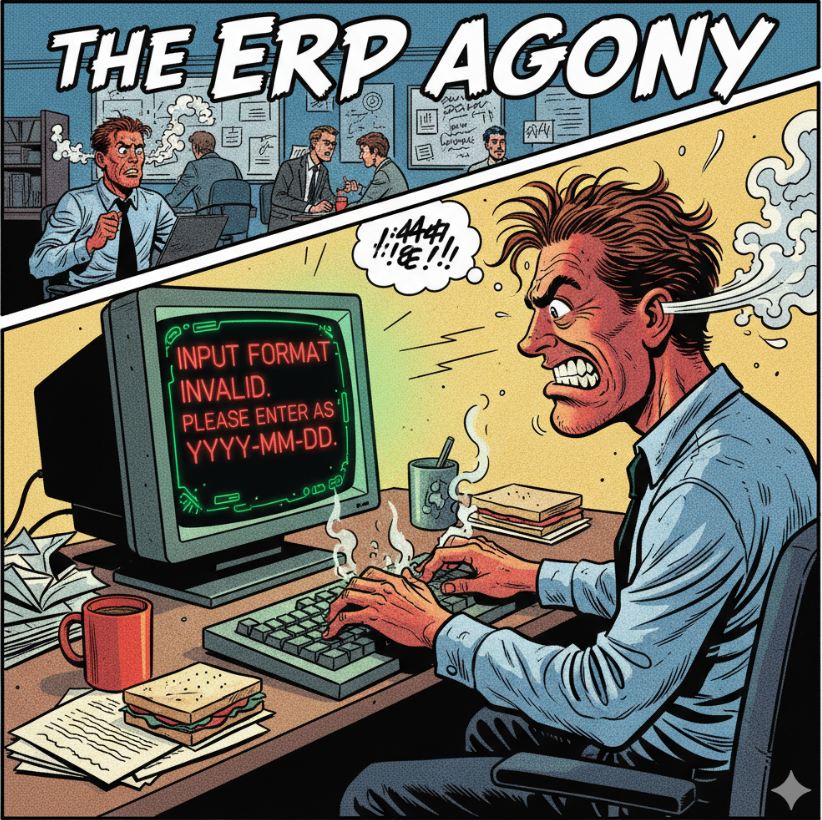
The question of whether the modern Enterprise Resource Planning (ERP) system is dying leads to a typical consultant’s answer: “it depends.” The costly, slow-to-change monolithic ERP is facing extinction, but the essential core function (finance, inventory, and operations) is non-negotiable for any business that wants an always up-to-date single source of truth to be able to make decisions.1
But the market is undergoing a transformation in how ERPs are built, shifting away from a single, all-in-one suite toward a flexible model built on two parts: Self-Composable Architecture and Intelligent Automation.
Executive Summary
Key Finding | Strategic Implication |
The Enduring Core: The need for a “single source of truth” for basic administrative processes (finance, inventory) is permanent.2 | Action: Maintain a stable, standardized Clean Core system.3 |
The New Architecture: The future for small and medium sized businesses is modular. Companies are shifting to Composable ERP, which involves stitching together applications via APIs to always have the best of the best.4 | Action: Prioritize time and money investments in centralized Integration Platforms (Orchestration Hubs) to manage data flow between systems. |
The Intelligence Mandate: ERP is transforming from a passive System of Record into an autonomous system. Now ERPs can make decisions or automate themselves by embedding Agentic AI into workflows.6 | Action: Use Low-Code/No-Code tools to build unique, competitive functions outside the core by the people doing the work, reducing reliance on slow, expensive custom coding and consultants.9 |
Call to action for business leaders: You eventually need to get out of spreadsheets and into an ERP. But that ERP should be built for easy connections, live/accurate data, and regulatory compliance, if you need it.
I. Why the Traditional ERP Is Dying
The threat to traditional ERP systems is largely self-inflicted, stemming from old architectural choices that created massive technical liabilities.
1. Customization Creates “Technical Debt”
Historically, ERP systems were heavily customized to fit unique business processes. This custom code is now a crippling “technical debt”.3 In the cloud world, vendors deliver continuous updates and security patches automatically.10 Extensive customization breaks this automation, making every update a risky, expensive, and time-consuming project that prevents innovation.3
2. The Rise of Specialized Software
The integrated ERP suite, which bundles all functions (HR, CRM, finance) into one package, cannot compete with specialized, Best-of-Breed (BoB) applications that focus on one area (international logistics, unique sales processes) or industry (food products, electronics).11 Organizations are choosing BoB solutions because the solution looks and feels like a custom solution due to the deep, superior functionality in their areas of interest.13
3. Compliance Demands Force Specialization
For highly regulated industries like Food & Beverage or pharmaceutical, generic ERPs often fail to offer mandatory functions like bi-directional lot traceability and precise shelf-life management (FEFO) as standard features . Attempting to customize a general system for this level of compliance increases risk and cost significantly.14 For these sectors, a specialized “vertical ERP” that handles compliance out of the box is often the only viable choice.16
II. Setting Up the New Cloud Architecture
The modern ERP system succeeds by embracing modularity, intelligence, and automation.
1. Composable ERP and the Clean Core
The new standard is Composable ERP, defined as using independent software modules that communicate seamlessly.4 This approach allows businesses to swap out components or add new ones quickly, dramatically improving business agility.17
To make this work, vendors enforce a Clean Core strategy:3 The central ERP must be kept standard and free of custom code, meeting regulatory and data governance needs. All differentiating customizations are moved to flexible, easily updated cloud extensions that connect via APIs, ensuring the core remains stable and ready for continuous vendor updates.5
2. The Intelligence Transformation (AI)
ERP systems are shifting from being static record keepers to autonomous operating platforms.18 Vendors are aggressively embedding
Agentic AI directly into their core functions 8:
- Automation: AI agents automate manual finance processes, leading to “touchless operations”.6
- Real-Time Insights: AI provides executives with real-time analytics, instantly spotting trends and anomalies that manual reporting would miss.7
- Usability: Conversational AI allows non-technical users to query and interact with the vast ERP data stores using everyday language, improving adoption.18
III. Trade-Offs and Risk
While modern solutions offer significant benefits, they replace old costs and complexities with new ones.
Implementation Costs Are Lower, But Integration Costs Are High
The shift to Cloud ERP has drastically reduced upfront capital expenditure (CapEx), replacing it with predictable subscription-based operational expenses (OpEx).10 Implementation time is also much shorter, moving from years to months to weeks.19
However, the data shows that this transition introduces new hidden costs and risks:
- Integration Complexity: In a modular environment, managing the connections (APIs) between different vendor systems becomes a never-ending task. This requires dedicated platforms, like Zapier, and specialized technical skills to prevent data silos and ensure data consistency. Or ensure every new application has a simple and smooth integration process.
- Vendor Management: Adopting a best-of-breed strategy means juggling multiple vendors, increasing the risk of support issues and “finger-pointing” when errors occur.11 It also brings about the risk of not having full transparency or association of all costs involved.
- Data Migration Risk: Up to 70% of ERP projects fail to meet their goals, often due to poor planning and, critically, migrating inaccurate or incomplete data from the old system.20 Ensuring clean data and robust data governance is the most vital step in any project, which again requires technical expertise.22
Call to action for business leaders:
You eventually need to evolve into a scalable ERP, and if you’re still in spreadsheets, get out of them. But that ERP should be determined by your business goals then built for easy connections, live/accurate data, and regulatory compliance, if you need it. Then build a team that can manage the change process and ensure your organization knows how to manage all the integrations as you grow your tech stack. You’ll never be future proof, so build the flexibility and expertise within your team.
By: Pedrom Rejai & Google Gemini September 30, 2025
https://elevategrowth.partners
© 2025 Elevate Growth Partners. All rights reserved.
Works cited
- ERP Is Dead… Sort Of: Why the Future of Enterprise Tech Is Bigger …, accessed September 30, 2025, https://www.thirdstage-consulting.com/erp-is-dead/
- Predictions 2025: A Year Of Reckoning For Enterprise Application Vendors – Forrester, accessed September 30, 2025, https://www.forrester.com/blogs/predictions-2025-enterprise-software/
- The State of ERP in 2025 – CoreX Corp., accessed September 30, 2025, https://corexcorp.com/insights/the-state-of-erp-in-2025
- Choosing the Right Food Traceability Software: Features That Matter Most – Aptean.com, accessed September 30, 2025, https://www.aptean.com/en-US/insights/blog/best-food-traceability-software-features
- Food Manufacturing ERP Software, accessed September 30, 2025, https://sg.syspro.com/industry-specific-software/manufacturing-software/food-manufacturing-software/
- Oracle Enterprise Resource Planning (ERP), accessed September 30, 2025, https://www.oracle.com/erp/
- ERP for Food Manufacturing: industry specific benefits and features – Rsult, accessed September 30, 2025, https://rsult.one/erp-per-industry/erp-for-food-manufacturing-industry-specific-benefits-and-features/
- NetSuite vs. Microsoft Dynamics 365 Business Central: Which ERP Is Right for Your Business? – Calsoft Systems, accessed September 30, 2025, https://www.calsoft.com/netsuite-vs-microsoft-dynamics-365-business-central/
- Best-of-Breed vs. ERP Software: the Right Solution for Your Business, accessed September 30, 2025, https://www.crosscountry-consulting.com/insights/blog/best-of-breed-vs-erp-software/
- Composable ERP – New Era of ERP – Infosys Blogs, accessed September 30, 2025, https://blogs.infosys.com/infosys-cobalt/public-cloud/composable-erp-new-era-of-erp.html
- SaaS for Restaurants | Restaurant Saas That Boost Efficiency & Profitability, accessed September 30, 2025, https://saasforrestaurants.com/
- NetSuite vs Dynamics 365 BC Independent Review 2024 – ElevatIQ, accessed September 30, 2025, https://www.elevatiq.com/post/netsuite-vs-dynamics-365-bc/
- 2025 SAP Activate Roadmap: 6 Expert Steps to a Flawless S/4HANA Upgrade, accessed September 30, 2025, https://tekleaders.com/sap-activate-roadmap-s4hana-upgrades-2025-step-by-step-guide/
- ERP VS Best of Breed Blog: What You Need to Consider – Lumenia Consulting, accessed September 30, 2025, https://lumeniaconsulting.com/insights/blogs/erp-vs-best-of-breed
- Bridging the Gaps in ERP Systems for Food and Beverage Manufacturing, accessed September 30, 2025, https://tracktile.io/blog/gaps-erp-food-beverage-manufacturing
- Compare Food ERP Software – Pricing, Reviews, Features – ERP Focus, accessed September 30, 2025, https://www.erpfocus.com/food-beverage-erp.html
- Top Mobile & Cloud ERP Systems for Food Manufacturing in 2025 – Dexciss Technology, accessed September 30, 2025, https://www.dexciss.io/blog/educational-6/top-mobile-cloud-erp-systems-for-food-manufacturing-in-2025-182
- Complexities of ERP Data Integration in Modern Businesses – Skyvia Blog, accessed September 30, 2025, https://blog.skyvia.com/overcoming-erp-data-integration-challenges/
- Is ERP Dead? Why Incremental Modernization May Be Smarter Than a Full Replacement, accessed September 30, 2025, https://www.thirdstage-consulting.com/is-erp-dead/
- 5 Lessons Learned from Failed ERP Implementations – CLA Digital, accessed September 30, 2025, https://godigital.claconnect.com/insights/article/5-lessons-learned-from-failed-erp-implementations/
- 6 ERP Data Migration Challenges (& Their Solutions) – Panorama Consulting, accessed September 30, 2025, https://www.panorama-consulting.com/erp-data-migration-challenges/
- What Is Cloud ERP? A Complete Guide for 2025 – Bizowie, accessed September 30, 2025, https://bizowie.com/what-is-cloud-erp-a-complete-guide-for-2025/
- How to Tackle Legacy ERP Data Migration Challenges Without Disrupting Business Continuity – TeamBlueSky, accessed September 30, 2025, https://www.teambluesky.com.au/how-to-tackle-legacy-erp-migration-challenges-without-disrupting-business