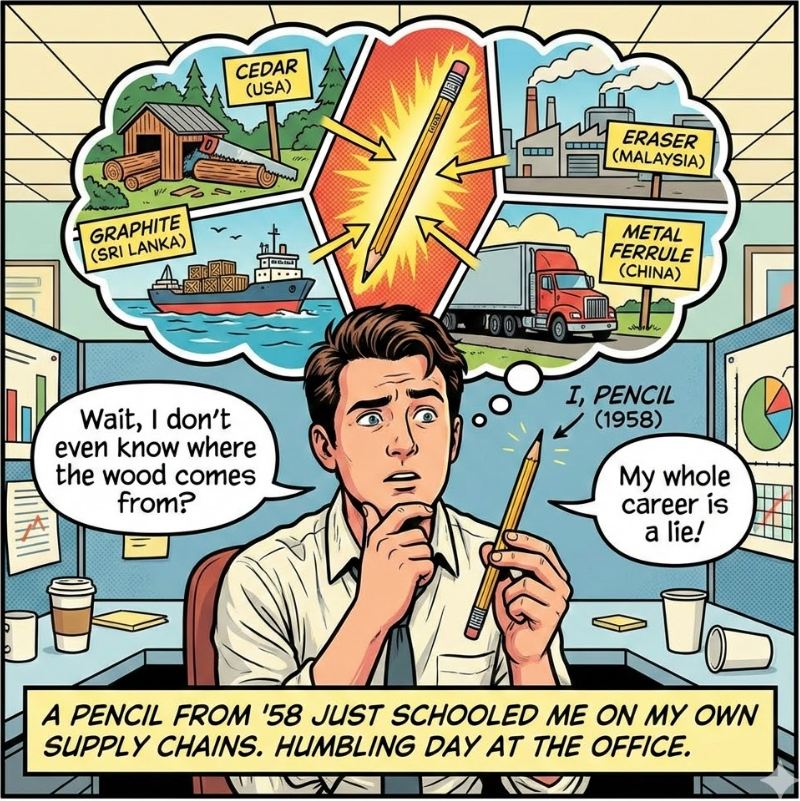
A podcast recently mentioned Leonard Read’s 1958 essay, “I, Pencil,” where a pencil explains that no one person knows how to make it. Its parts come from all over the world—wood from Oregon, graphite from Sri Lanka, clay from Mississippi, wax from Mexico. Thousands of people, most never seeing the final product, all contribute. It hit me: that’s every supply chain I’ve worked in.
Let’s take the humble bar of soap.
Early in my career at Unilever, I worked in a Dove Bar soap factory. I remember walking through that plant and being genuinely humbled by the sheer number of things that had to come together just to make a bar of soap: sustainable palm oil from Indonesia, fragrances from Europe, colorant from Texas, and on and on and on.
Then the equipment to make the soap had just as much diversity: machinery from Germany, programmers from the USA, and case packers from France. And the list goes on.
Each of these inputs had its own supply chain, hiding one or two levels deeper, with thousands of people contributing. This deep complexity wasn’t understood anywhere in our company, suppliers, or customers, but somehow, each party involved knew their piece of the puzzle. It was the magic of a humble bar of soap.
The Kiwi Is the New Pencil
Now we travel to the modern grocery store: Mexican guacamole, stacked under a Super Bowl display made in Missouri, scanned by a barcode reader made in China, carried by a bag made in India. Every aisle is a story of our incredibly global economy, along with the millions of people who made it happen, most of whom will never meet each other.
The “I, Pencil” essay was written in 1958, and a lot has changed since then. The scale is bigger, regulations are more complex (and safer), and the technology is faster. So shopper expectations have followed: price, convenience, and quality all must be at the shelf 100% of the time. The paradox is that the core truth hasn’t changed in 70 years, as no single person knows the entire supply chain. Not for a pencil. Not for a bar of soap. Not for your guacamole.
So where’s the magic?
If you’re breaking into a new supply chain, the instinct is to fix everything wrong with it. Map it all out, then optimize or completely rethink what “local” really means. That’s a great instinct, and I believe it’s incomplete.
The founders and operators I’ve seen scale most successfully share a common trait. They lead with curiosity, exploration, and basic questions to fully understand without drawing assumptions. They respect the institutional knowledge that’s already there, the people who’ve been running it long before they showed up and will be there long after they’re gone.
That’s the people-first approach to any transformation that touches your supply chain. 70 years after “I, Pencil” was published, information is free and abundant, and AI can sort through any complex, interconnected supply chain. Counter-intuitively, they’re even more human-driven because each person in that chain makes the decisions to change, improve, or partner after noticing the patterns of what can and should change in each supply chain.
The Pencil’s Lesson, 70 Years Later
Leonard Read’s point in 1958 was about the miracle of free markets and cooperation. My main lesson for today is clearer: approach any supply chain transformation with humility and curiosity. Nobody truly knows the entire process, so explore, respect, and learn as you go. This people-first mindset is how you contribute to building the world’s next pencil.
📖 Read the original essay here: I, Pencil — Leonard Read, 1958
🤝 Ready to explore your own supply chain? That’s what we do.